For one week in February 2026, Boralen Journal documented the meal environments of forty-two individuals across three London boroughs. The question was not what they ate, nor how much — it was where their attention resided during the eating period. The findings, documented here without prescriptive interpretation, form a portrait of the contemporary London meal environment that is characterised above all by the persistent presence of a screen.
The Field Methodology
Participants were asked to log their meals for seven consecutive days using a structured observation journal developed by the Boralen editorial team. The journal captured meal start and end times, the eating environment (desk, dining table, sofa, public space), the presence of a screen during the meal (television, laptop, smartphone, handheld device), and a self-reported attention rating on a simple three-point scale: fully present, partially present, or absent.
The observation period covered breakfast, lunch, and evening meals. Snacks and incidental food consumption — a biscuit at the kettle, a handful of nuts during a video call — were recorded separately, as a secondary data category. This distinction between structured meals and incidental eating was methodologically significant: the patterns that emerged differed markedly between the two categories.
What follows is not a statistical report but an editorial account of the patterns the observation surfaced. Boralen Journal does not publish research. It publishes observation. The distinction matters.

What the Observation Week Produced
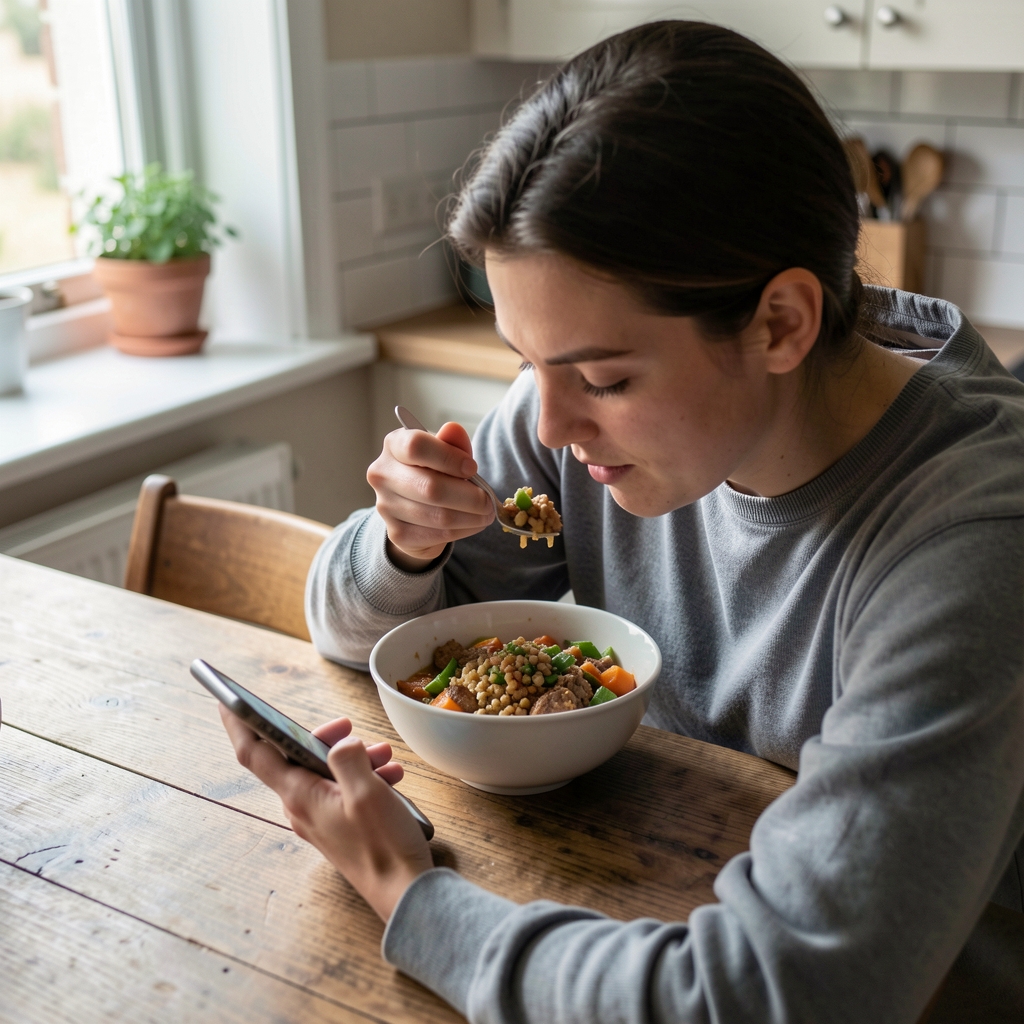
Of the 294 structured meals logged across the seven-day observation period, 211 were accompanied by a screen of some kind. That is approximately 72% of all meals. The breakdown by meal type showed a pronounced gradient: screens were present at 91% of lunches, 83% of breakfasts, and 48% of evening meals. The evening meal was the only mealtime at which a screen-free environment was the more common experience.
The self-reported attention ratings tracked the screen presence data closely. Meals logged as "fully present" occurred predominantly in the screen-free evening meal category. Meals logged as "absent" — where the participant reported that their attention was primarily located in the screen content rather than the food — were almost exclusively desk lunches with laptop or workplace screen engagement.
The most frequently noted observation in the journal free-text fields was not about screen presence per se but about the pace of eating when screens were present. Participants noted, repeatedly and without editorial prompting, that meals eaten in front of a screen felt faster — that they had finished before they were aware of having begun. This observation aligns with published food-pace research on eating and attention: the screen does not accelerate the physical act of eating, but it compresses the subjective experience of meal duration.
"They had finished before they were aware of having begun."
— Field observation note, February 2026
The Meal Environment as Variable
Published research on eating and screens identifies the meal environment — the physical and attentional context in which food is consumed — as a significant variable in eating pace and portion awareness. The mechanism is attentional rather than physiological: a screen-rich meal environment does not alter digestion, but it does redirect the cognitive resources that might otherwise be directed at the eating experience itself.
The reduction in attentional presence during a meal has two documented downstream effects in food-pace research. First, it is associated with faster eating pace — the fork-to-mouth rate increases when attention is not directed at the food. Second, it is associated with reduced registration of satiety signals — not because those signals are not produced, but because the attentional resources that might notice them are directed elsewhere.
It is worth noting that these two effects compound. A faster eating pace reduces the time window during which satiety signals might arrive before the meal is completed. An inattentive eating environment reduces the likelihood that those signals, even when present, will register. The combination is not unusual. It is, the observation week suggested, the standard condition of the London lunch.

The Evening Meal Exception
The evening meal data was the most interesting in the observation set. It was the only mealtime at which screens were present in fewer than half the logged instances, and it was also the mealtime with the highest concentration of self-reported "fully present" attention ratings and the longest average meal durations — approximately 23 minutes, compared to 9 minutes for the observed desk lunch.
The evening meal environment also differed structurally from the lunch environment: it more frequently occurred at a dedicated eating surface (a dining table or kitchen table), more frequently involved another person, and less frequently involved a professional obligation time constraint in the immediately following period.
What the evening meal data illustrates is that the conditions associated with greater meal attention — a surface designated for eating, the presence of social context, an absence of an imminent deadline — are available to most of the observation participants at least once a day. The question is structural: why are those conditions concentrated in the evening rather than distributed across all three mealtimes?
The answer, as in the earlier article on hurried lunches, returns to the architecture of the working day. The evening meal is protected from time pressure by the absence of scheduled obligations in its immediate aftermath. The lunch is not. The breakfast is not, for most working adults. Screen presence follows the pressure gradient.
The Snacking Category
The incidental eating category — snacks and unstructured food consumption — presented a distinct pattern. Screen presence during snacking was nearly universal: 94% of all logged snack instances occurred with a screen present. Self-reported attention during snacking was overwhelmingly "absent." And snack durations were, by their nature, not tracked in the same way as structured meals.
What the snacking data suggests is that the incidental eating category functions as an almost entirely screen-concurrent behaviour in the observation population. Food is consumed without a dedicated eating period, in the margins of screen activity, and without the attentional frame that a structured mealtime might provide.
The editorial observation here is not that snacking is problematic. It is that snacking-as-screen-concurrent-behaviour is a structurally different eating pattern from structured meals — even screen-concurrent structured meals — and that the distinction between the two is worth maintaining in any honest account of everyday eating habits in contemporary London life.
Toward a Meal Attention Record
The observation week produced a body of field data that Boralen Journal will continue to develop. The meal attention record — a simple log of where attention is directed during eating — is a more granular and arguably more informative instrument than a food diary that records only what was eaten.
What we eat is, in part, a function of how we eat — of the pace, the environment, and the attentional quality of the eating period. The meal attention record captures the how, not just the what. The Boralen editorial team intends to publish further observation records from this methodology over the coming months.
For readers interested in applying a similar observation to their own eating habits, the recommendation is simply this: note what is in the room when you eat. The screen question resolves itself, over a week of honest logging, into something more interesting than an abstraction about mindful eating pace. It becomes a portrait of time.
- — 72% of structured meals observed over the seven-day period were accompanied by a screen of some kind; the proportion was highest at lunch (91%) and lowest at the evening meal (48%).
- — Screen-concurrent eating was associated in participant self-reports with faster subjective meal pace and reduced awareness of meal completion.
- — The evening meal showed the most attentive eating environment and the longest meal durations — a pattern associated with the structural absence of time pressure in the post-meal period.
- — The meal attention record — noting where attention is directed during eating, not just what is consumed — is proposed as a more descriptive tool for understanding everyday eating habits.
Articles published on Boralen Journal are editorial in nature and reflect the writers' observations on eating pace, convenience food habits, and everyday meal behaviour. The content is not intended as professional advice, nor as guidance for the management of any specific condition. Readers with specific concerns about their eating habits are encouraged to speak with a qualified wellness professional.